Etruscan Hut Urns
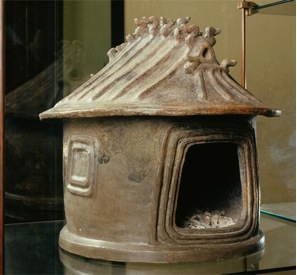
Etruscan hut urn (c. 800 B.C.E.), impasto (Vatican Museums)
https://smarthistory.org/the-etruscans-an-introduction/
In Etruscan burial practices, the use of urns, used to house the cremated remains of the deceased, was considered the most common practice. I have chosen to write about the Etruscan hut urns. I like the design of these urns, especially for that time period. Comparing them to now, the urns back then were a lot more appealing. They were far more personal and there were reasonings as to what urn was made for each person. Personally, I think that this is an important aspect to consider and it's always fascinating to read about these cultures and their burial traditions. It's a nice sentiment learning about these burial traditions because, these days, it doesn't seem like there is a lot of thought put into these practices - at least, not like there used to be. These traditions strike me to be something that we should still include, in a way, in our own burials.


(left) Cinerary hut urn (c. 800 B.C.E.), impasto (Museum-on view), (right) Etruscan hut urn (c. 700 B.C.E.), impasto (Museum of Art & History, Geneva)
https://www.library.fordham.edu/digital/collection/Hist/id/180
Hut urns were urns, made of clay, terracotta, or bronze, which were modeled after Etruscan homes. Some hut urns were modeled after domestic houses while others were modeled to represent more high-status homes. In architectural terms, their symbolic significance is debated between being a representation of the deceased’s home or the deceased’s home in the afterlife. In a sense, these urns were similar to the Egyptian thought of setting the person up for the afterlife, to be protected, and to resemble what they hoped the afterlife would be like for that person. Some of the hut urns had thatched roofs, others were more cylindrical with geometric patterns. Occasionally, the roof of the hut urn might don a humanistic or animalistic figure of symbolic protection for the deceased. This particular urn (shown above) portrayed neither animalistic nor humanistic figures of protection but does depict what an Etruscan home most likely looked like. The cinerary hut urn featured below (left) is made of terracotta. It is from the same time period as the one featured above. It features a thatched roof as well as a humanistic figure, who appears to be in motion, as a symbol of protection for the deceased whose remains were kept in the urn. The hut urn featured below on the right features roof decorations and an aperture on the roof for smoke ventilation.
Cartwright, Mark, and Mark Cartwright. 2017. "Etruscan Pottery". Ancient History Encyclopedia. https://www.ancient.eu/Etruscan_Pottery/.


Comments
Post a Comment